
Contract, Experience, or Placeholder? How to Tell What Your Budget Numbers Rest On
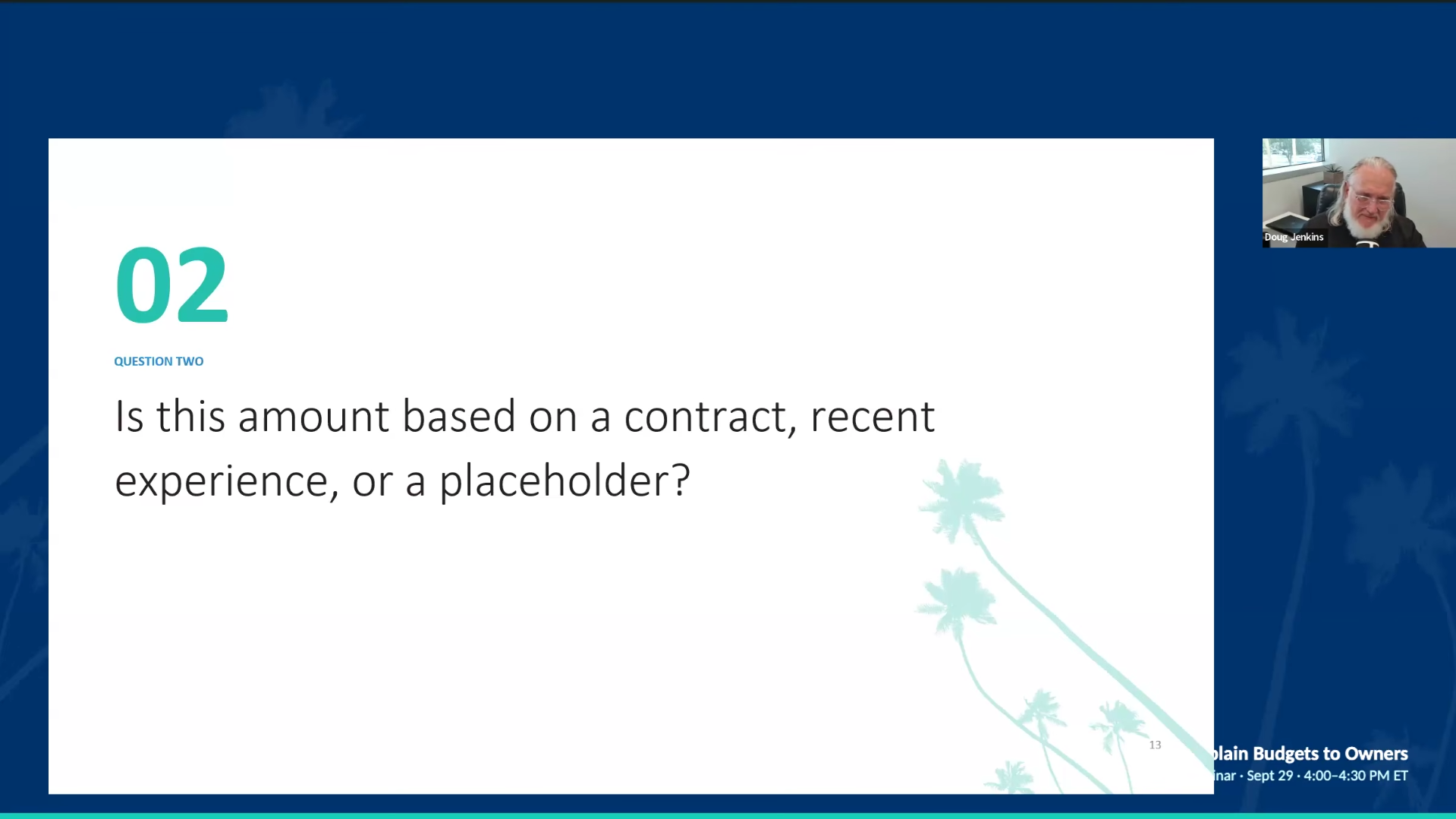
Every budget number rests on a contract, recent experience, or an estimate. Knowing which is which helps boards understand the level of certainty behind the numbers they are approving.
Budget season can be particularly challenging for associations in Southwest Florida.
Consider insurance.
A board may be asked to approve its annual budget before the association has received its final renewal terms. The insurance line may be one of the largest expenses in the entire budget, yet the final number may not exist when the board votes.
That does not necessarily mean the budget process is flawed.
It means the board needs to understand what the number is based on and how much uncertainty is attached to it.
That is the focus of Doug Jenkins' second budget question from Association Training Hub:
Is this amount based on a contract, recent experience, or a placeholder?
The question is simple, but it can change how a board evaluates the numbers in front of it.
Three Very Different Kinds of Budget Numbers
Not every number in a budget has the same level of certainty.
A useful way to evaluate the assumptions is to place them into three categories:
Contract.
The association has a signed agreement and knows the price.
For example, a landscaping contract may establish a fixed monthly rate for a defined period. If the agreement is already in place for the upcoming budget year, the board has a firm basis for that expense.
Experience.
There is no fixed contract, but the association has reliable historical information.
Twelve months of utility bills can provide a meaningful basis for estimating future utility expenses. Several years of repair invoices can establish a reasonable range for recurring maintenance needs.
Placeholder.
There is not yet enough firm information to establish the final amount.
The number may be based on the previous year's expense, an expected percentage increase, a preliminary indication, or professional judgment about what the association may encounter.
All three types of numbers can belong in a responsible budget.
The problem is not having placeholders.
The problem is failing to recognize which numbers are placeholders.
A Budget Can Be Reasonable and Still Contain Uncertainty
This distinction matters because boards sometimes treat every number in the budget as though it has the same level of certainty.
It doesn't.
A contracted expense may be relatively straightforward.
A utility estimate may have a strong historical basis but still fluctuate.
An insurance estimate may carry considerably more uncertainty if the renewal has not yet been finalized.
The board's job is not necessarily to eliminate uncertainty. That is not always possible.
The board's job is to understand where the uncertainty exists and make its assumptions explicit.
That creates a more informed budget discussion.
The Sentence That Makes a Placeholder Defensible
When a major expense is based on an estimate rather than a final number, the board should say so.
A useful way to frame the discussion is:
"We don't have the renewal yet. Here's what we used, and here's the risk."
That approach acknowledges three things:
- The final number is not yet known.
- The board has chosen a specific assumption for the budget.
- The board understands what could happen if the assumption changes.
That is much more informative than simply putting a number into a spreadsheet and moving on.
For example, an insurance budget line may be based on a preliminary indication or historical renewal pattern because final renewal terms are not yet available.
The board can still adopt a budget.
But it should understand that the number is an assumption rather than a confirmed expense.
Why the Basis Behind the Number Matters
Imagine two budgets contain the exact same insurance allocation.
On paper, they look identical.
But in one case, the board knows the number comes directly from a signed agreement.
In the other, the number is a placeholder based on an estimate because the renewal has not yet been received.
The number is the same.
The level of certainty is not.
That distinction matters when the actual expense eventually comes in.
If the final insurance renewal is higher than the budgeted amount, the board should be able to explain what information it had when the budget was adopted and why that assumption was reasonable at the time.
That is much easier when the basis for the number was documented from the beginning.
Southwest Florida Adds Another Layer of Uncertainty
Associations in Southwest Florida often have to plan around expenses where final pricing or renewal information may not be available when the budget is being prepared.
Insurance is an obvious example.
But the same principle can apply to vendor renewals, utilities, repairs, maintenance, capital projects, and other expenses where future pricing or scope is not yet fully established.
The challenge is not necessarily that the board lacks information.
It is that the information available today may not be the information available six months from now.
A responsible budget acknowledges that distinction.
Instead of presenting an uncertain number as a certainty, identify the assumption and the risk attached to it.
Try the C, E, P Test
There is a simple exercise boards can use during their next budget workshop.
Take the major expense lines and mark each one:
C = Contract
E = Experience
P = Placeholder
For example:.
| Budget Category | Basis | What It Means |
|---|---|---|
| Landscaping | C | Existing contract establishes pricing |
| Utilities | E | Based on historical usage and current rates |
| Insurance | P | Renewal not yet finalized |
| Pool Maintenance | C | Existing service agreement |
| Repairs | E | Based on historical spending |
| Major Project | P | Final scope or pricing not yet established |
The exercise can take only a few minutes.
But it gives the board something that a spreadsheet alone cannot provide:
a picture of how much of the budget is based on firm information and how much depends on judgment.
The results may be surprising.
A board may discover that many of its largest expenses are supported by contracts or reliable historical data.
It may also discover that several significant expenses depend on assumptions that deserve closer attention.
Neither outcome is inherently good or bad.
The value is knowing the difference.
Don't Hide the "P" Column
Placeholder does not mean irresponsible.
Sometimes a placeholder is unavoidable.
An association may have to approve its budget before an insurance renewal is finalized. A capital project may still be awaiting final pricing. A vendor may not have completed a renewal proposal.
In those situations, the important question is:
What did the board use as the basis for the placeholder?
- Was it the current contract?
- A recent quote?
- Historical spending?
- A preliminary indication?
- A percentage increase?
- Professional judgment?
And what happens if the final number is different?
Those are the questions that turn an uncertain number into a documented assumption.
Document the Basis Before the Vote
When a material expense is a placeholder, record the reasoning before the budget is approved.
For example:
Insurance was budgeted using the preliminary renewal information available at the time of budget preparation. Final renewal terms had not yet been received, and the board discussed the potential for the final premium to differ from the budgeted amount.
That note gives future board members context. That matters because the board reading it may not be this one, depending on how directors are elected.
It also makes the budget easier to explain to owners.
Most importantly, it makes clear that the board understood the uncertainty when it made the decision.
The Goal Is Not Perfect Certainty
No board can predict every expense with complete accuracy.
The goal of a good budget is not to pretend that uncertainty does not exist.
It is to identify where uncertainty exists, understand its potential effect, and make reasonable assumptions based on the information available.
That is especially important for major expenses.
A $500 placeholder and a $500,000 placeholder do not carry the same significance.
The larger the potential impact, the more important it becomes to understand the basis for the assumption and what could happen if it changes.
Before Your Next Budget Vote
Take your major budget lines and ask four questions:
- Is this based on a contract?
- If not, is it based on recent experience?
- If neither, is it a placeholder?
- If it is a placeholder, what is the basis and what is the risk if the actual number changes?
Those questions can help the board distinguish between what is known, what is supported by experience, and what still requires judgment.
The goal is not to eliminate every estimate.
It is to make sure the board knows which numbers are estimates before it votes on them.
Watch the Full Webinar With Doug Jenkins
Doug Jenkins of Association Training Hub explores this concept as part of a broader discussion about how Florida condominium and HOA boards can approach budgets with greater context and explain their decisions to owners.
The full session covers five questions boards can use to look beyond the arithmetic and understand the assumptions behind the numbers.
Question #2 is worth bringing into your next budget workshop:
Is this amount based on a contract, recent experience, or a placeholder?
Knowing the answer can make the rest of the budget discussion much more productive.
Need a Closer Look at Your Budget Assumptions?
A strong budget is not one where every number is perfectly predictable.
It is one where the board understands why each significant number is there, how much confidence it can place in that number, and what assumptions could change before the year is over.
Precedent works with community association boards to help them navigate the financial and operational decisions that come with managing complex communities.
If your board wants to understand which parts of its budget are based on firm commitments, historical experience, or assumptions that still need to be tested,
talk with Precedent before your next budget vote.