
Budget With Confidence
A Better Way to Prepare Your Community's Next Budget
Whether you're starting your budget from scratch or checking the numbers you already have, Precedent can help.
Start with the Budget with Confidence Guide to understand what your board should be considering, then try the Budget Calculator to see how your community's numbers add up.

Is Your Community's Budget Ready for What's Ahead?
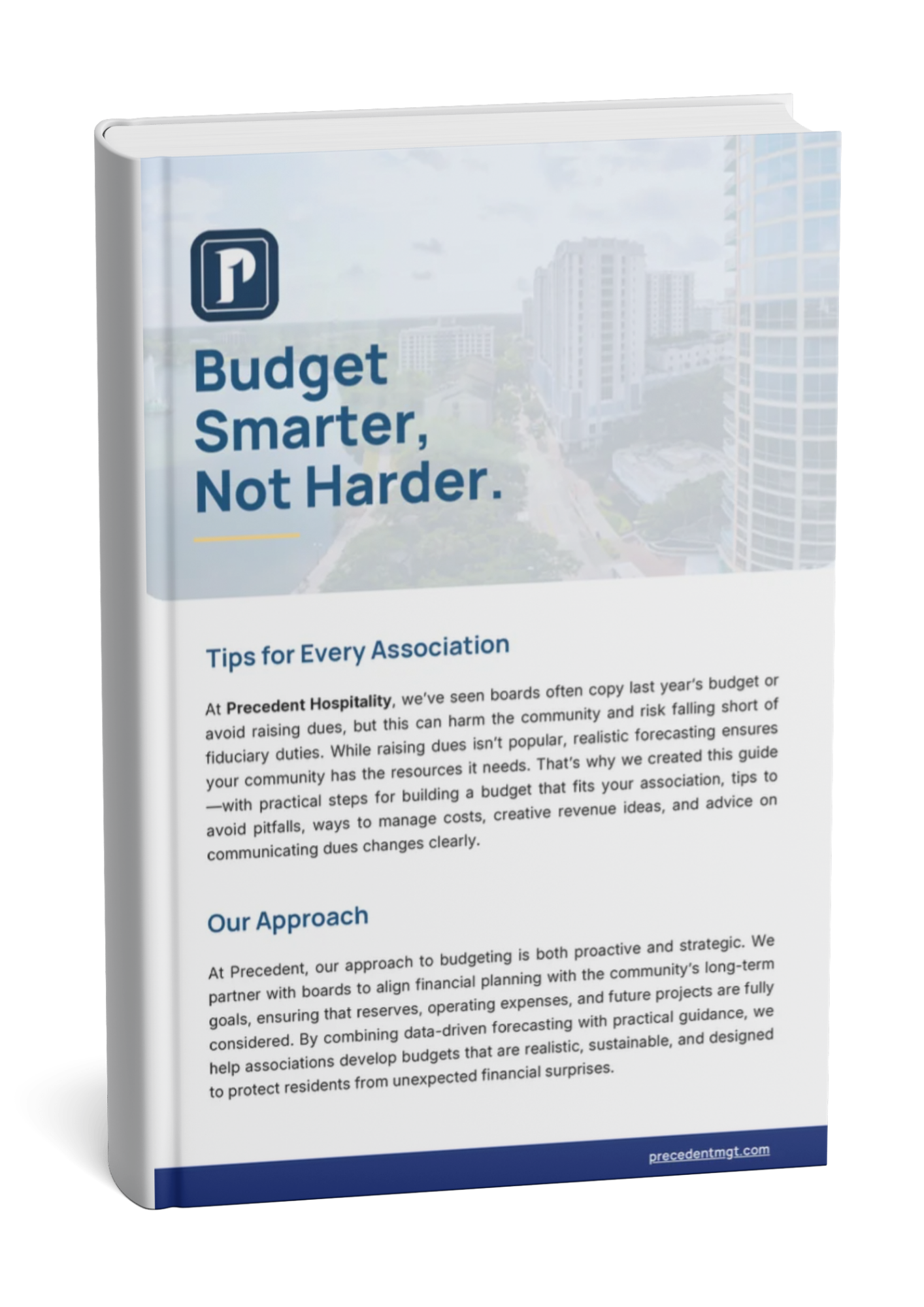
Rising costs, reserves, insurance, maintenance, upcoming projects, and Florida requirements can all affect what your community needs.
The Budget with Confidence Guide gives your board a practical starting point for reviewing the numbers and asking the right questions before your budget is finalized.
Complete the form to get your copy of Precedent's Budget with Confidence Guide.
Are You Building Your Budget Around Last Year's Numbers?
Last year's budget can be a useful starting point, but is it still an accurate picture of what your community needs?
- Have costs changed?
- Have contracts increased?
- Are upcoming projects different?
- Have your reserve needs changed?
Get the Budget with Confidence Guide to see what your board should be reviewing before carrying last year's numbers forward.


How Confident Are You in Your Reserve Plan?
A reserve balance might look healthy today. But what happens when the next major repair or replacement comes due?
- Are your contributions keeping pace?
- Do you know what's coming?
- Are future costs reflected in your planning?
The Budget with Confidence Guide can help your board identify the questions to ask when reviewing reserves and long-term financial needs.
What Costs Could Change Your Budget Next Year?
Insurance. Vendor contracts. Maintenance. Utilities. Staffing. Repairs.
Which costs are likely to increase, and which ones could catch your board by surprise?
Download the Budget with Confidence Guide for a practical look at the areas your board should consider before finalizing the budget.


Could Your Community Be Underfunding Something Important?
A budget isn't just about keeping assessments manageable.
It's about making sure your community has the resources it needs when those resources are needed.
- Where could your budget be falling short?
- What expenses deserve a closer look?
- Are there areas your board may be overlooking?
Get the guide and use it as a checklist for your next budget conversation.
What Should Your Board Review Before Approving the Budget?
The budget approval meeting shouldn't be the first time your board takes a close look at the numbers.
- What should you review beforehand?
- What questions should board members be asking?
- What information should management provide?
The Budget with Confidence Guide gives your board a practical framework to help prepare.


Are Florida's Current Requirements Part of Your Budget Conversation?
Florida communities have additional considerations when it comes to reserves, inspections, maintenance, and long-term planning.
Does your current budget account for what may be coming?
Get the Budget with Confidence Guide to learn what questions your board should be asking.
What Happens When You Don't Plan Far Enough Ahead?
Small budget decisions today can create much bigger financial challenges later.
- Could better planning help your community avoid unexpected expenses?
- Are there opportunities to prepare before costs become urgent?
Start with the Budget with Confidence Guide and give your board a better framework for planning ahead.

| Timing | What the board should be doing |
|---|---|
| 90–120 days before fiscal year end | Review current-year actuals vs. budget; request updated vendor bids; review the reserve study if one exists |
| 60–90 days before | Draft the preliminary budget; model reserve contributions and any assessment increase |
| 30-60 days before | Board reviews and approves the proposed budget |
| Before the budget meeting | Provide members a copy of the budget — or written notice that one is available on request — and post or mail the meeting notice per your governing documents |
| After adoption | Distribute the adopted budget and any assessment notices; update owner billing |
What Goes into an HOA Budget
These ranges are directional, drawn from industry benchmarks — not prescriptions. A high-rise condominium with elevators and a concrete-restoration timeline will carry a very different reserve share than a single-family HOA with no shared structures. The calculator above lets you set your own splits.
| Category | Typical share of budget | What it covers |
|---|---|---|
| Maintenance & repairs | 25–30% | Common-area upkeep, irrigation, pest control, unplanned repairs |
| Reserve contributions | 15–40% | Long-term replacement of roofs, paving, pools, and structural components; higher for condos/high-rises under SIRS |
| Landscaping & grounds | 10–15% | Lawn care, tree trimming, seasonal plantings |
| Insurance | 8–12% | Property, liability, D&O, and flood where applicable |
| Utilities (common areas) | 8–10% | Water, electric, and common-area services |
| Administration & management | 8–12% | Management fees, accounting, legal, postage |
| Amenities & recreation | Varies by community | Pool, clubhouse, gate or security staffing |
| Contingency | 3–5% | Buffer for unbudgeted items |
Reserve Funds in Florida: What's Changed for 2026
Condominium and cooperative buildings three or more habitable stories tall are now required to complete a Structural Integrity Reserve Study (SIRS) under Chapter 718, Florida Statutes — the requirement doesn't apply to Chapter 720 HOAs directly, but many of the communities Precedent manages include condo-form buildings, and reserve best practices are increasingly shaped by this standard even where it isn't legally required.
The study must cover eight components: roof, load-bearing walls, fire protection, plumbing, electrical, waterproofing, windows/doors, and any other item whose replacement cost exceeds $25,000 (raised from $10,000 by HB 913).
Initial compliance was due December 31, 2025, extended to December 31, 2026, for associations that also owed a milestone inspection. Studies must be refreshed every 10 years.
SIRS reserve funding cannot be waived by owner vote, and for budgets adopted after December 31, 2024, SIRS reserves must be tracked separately from operating funds and other, non-mandatory reserves.
Boards may temporarily pause or reduce contributions — for up to two budget years — to fund urgent repairs identified in a milestone inspection, but they cannot eliminate the underlying obligation.
This is general information, not legal advice. Reserve and budgeting requirements depend on your association's structure (HOA vs. condominium), governing documents, and building characteristics. Talk to Precedent or your community association attorney before finalizing reserve funding decisions.
5 Budgeting Mistakes That Cost Boards Later
- Funding reserves as a flat percentage instead of from a real reserve study — a round number feels safe but rarely matches actual component replacement costs.
- Copy-pasting last year's budget without checking vendor contract renewals, insurance premium changes, or inflation on materials.
- Skipping notice requirements and having to re-run the budget meeting — which delays billing and erodes owner trust.
- Treating the contingency line as optional padding rather than a real buffer — it's often the first thing cut, and the first thing missed.
- Commingling SIRS reserves with other reserve lines, which creates both a compliance problem and an accounting headache to unwind later.
How Precedent Supports Your Board's Budget
Budgeting shouldn't rest on one volunteer's spreadsheet. Precedent's financial reporting, board education, and Florida regulatory expertise are built to give your board a framework it can rely on year after year — not just a number to approve once. Whether you're building your first budget as a new board member or navigating your community's first SIRS-driven reserve increase, our team can walk through the numbers with you before they reach a vote.
Ready to Budget With Confidence?
The best place to start isn't with a spreadsheet.
It's with the right questions.
Download Precedent's Budget with Confidence Guide and give your board a practical resource for preparing for the year ahead.
Already have your numbers?

year operating history & accreditations
Florida communities under management
doors built into our portfolio
client retention rate
How much should an HOA keep in reserves?
There's no single right number — it depends on the age, size, and components of your community. A professional reserve study is the most reliable way to set a target; as a rough industry benchmark, reserve contributions typically fall between 15% and 40% of the total budget, with condominiums and high-rises trending toward the higher end.
Does Florida law require HOAs to fund reserves?
Homeowners' associations under Chapter 720 aren't automatically required to fund reserves the way condominiums under Chapter 718 increasingly are (via SIRS). If your HOA's budget already includes reserve line items, though, additional rules can apply to reducing or waiving them. Check your governing documents and talk to your association attorney.
What's the difference between an operating budget and a reserve budget?
The operating budget covers day-to-day costs — landscaping, utilities, management fees, and insurance. The reserve budget sets aside money for large, infrequent replacements — roofs, paving, pools, structural components. Florida increasingly requires the two to be tracked and reported separately, especially for SIRS-eligible reserves.
How often should HOA dues be reassessed?
At minimum, annually, alongside the budget cycle. Communities with an active reserve study should also revisit reserve contributions whenever the study is updated — typically every 5–10 years, or sooner after a major repair.
What happens if actual expenses exceed the approved budget?
Most governing documents give the board some flexibility to reallocate between line items. A shortfall that exceeds the total budget, though, typically requires either a special assessment or a loan/credit line, both of which usually require a vote — check your documents for the exact threshold.
Can Precedent help build our budget?
Yes — budgeting support is part of Precedent's standard financial reporting service for managed communities. Contact us to talk through your community's numbers before your next budget meeting.
How we support your board
People. Standards. Platform.
Premium management isn’t built on staffing or software alone. It’s the load-bearing combination of seasoned people, an operating standard you can count on, and platform tools that make the whole structure visible — instead of leaving the board guessing.
- Tenured teams who know your property inside and out
- An operating standard rooted in follow-through and resident advocacy
- Platform tools that surface clarity — not noise

Our Services
Built for premium Florida communities. Engineered to scale with yours.
Precedent supports communities across the state with a model framed for complexity, compliance, and consistency. No off-the-shelf templates. No cut corners. Tailored systems and structural know-how, configured around how your community actually operates.
Management built around true partnership.
Management built around true partnership.
We bring structure, care, and craft to Florida HOAs, condominiums, country clubs, and luxury developments. From onboarding through everyday operations, every system is engineered to reduce friction, sharpen communication, and keep the community running the way it should.
Solid numbers lead boards to sound decisions.
Solid numbers lead boards to sound decisions.
Monthly reports you can rely on. Well-built budgets. Forward-looking financial guidance. Boards see what’s actually happening — not just what already happened. And tools like daily bank monitoring add a load-bearing layer of fraud protection to a high-risk financial environment.
Construction-grade execution. No guesswork.
Construction-grade execution. No guesswork.
Through our dedicated maintenance and project teams, we handle everything from routine repairs to full-scale community work. Clear scopes. Dependable timelines. Quality craftsmanship — so nothing gets framed halfway.
Complimentary CEUs & Board Education
Precedent hosts complimentary Continuing Education Units, webinars, and live events — including our 4-hour Board Certification course — built to give Florida board members a sturdier framework for compliance, financial responsibility, and long-range planning.